Mild hyperbaric at 1.4–1.6 ATA: how to market a chamber without overselling it.
Mild hyperbaric chambers are not clinical HBOT, and the fastest way to lose trust is to talk as if they are. Here is the evidence, the language that stays safe, and the content that actually fills sessions.
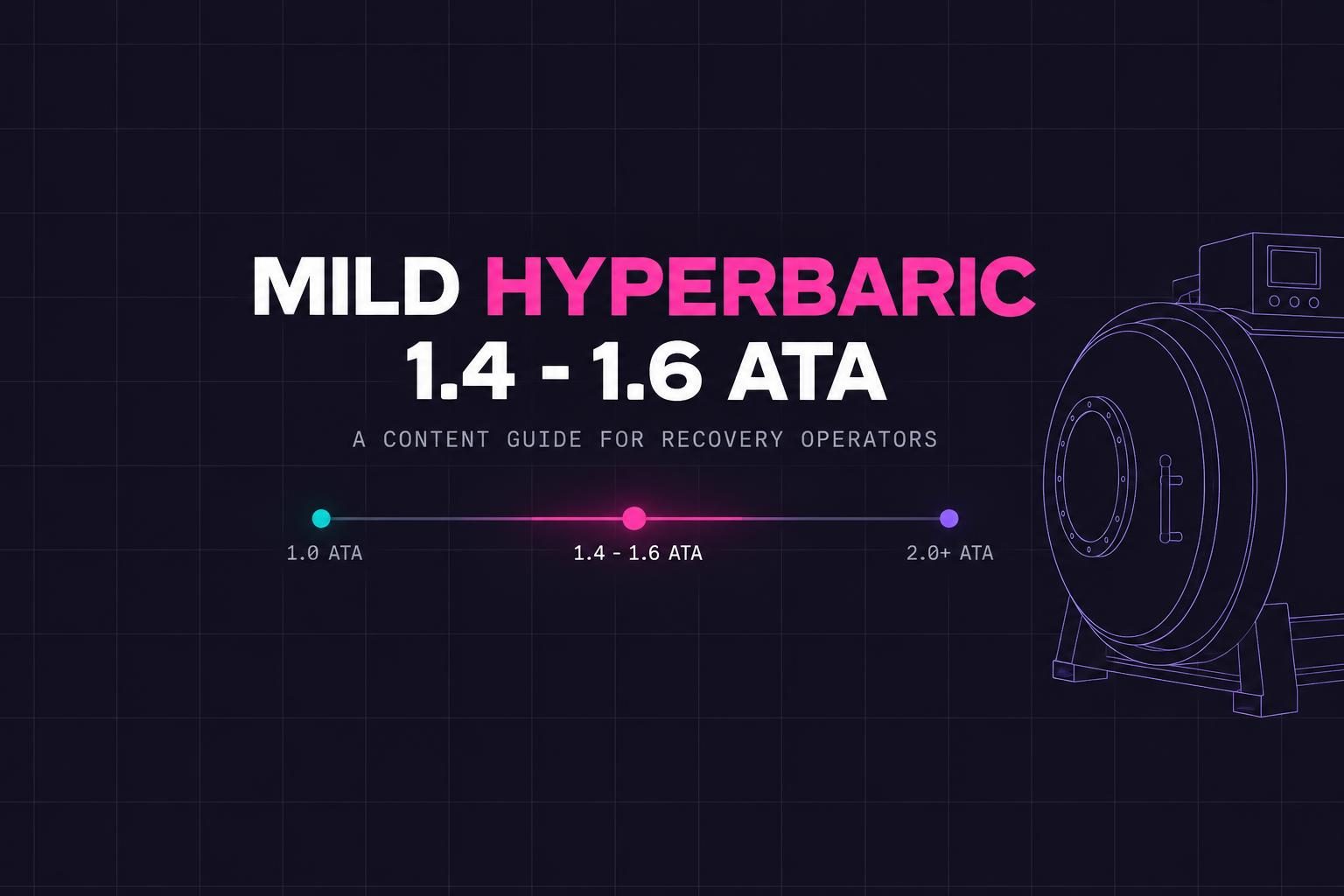
Mild hyperbaric chambers have moved from elite sport into everyday recovery studios, and the marketing has raced ahead of the evidence. Operators inherit claims from equipment suppliers, repeat them on a booking page, and end up promising outcomes the research does not support. The irony is that honest content converts better, because the audience considering a chamber is already sceptical and reads everything.
The operators winning on this category are not the ones claiming the most. They are the ones explaining it most clearly.
Mild hyperbaric is not clinical HBOT.
This is the distinction that governs every sentence you write. Clinical hyperbaric oxygen therapy runs at 2.0 atmospheres absolute or higher with 100% oxygen, under medical supervision, for a defined list of approved indications. Mild hyperbaric therapy runs at roughly 1.3 to 1.6 ATA, usually with ambient air or a modest concentrator, in a wellness setting.
Borrowing clinical outcomes to sell a mild chamber is the single most common mistake in the category. It is also the one most likely to attract regulatory attention, because the outcomes being quoted were produced at a pressure and oxygen concentration your chamber does not reach.
Mild hyperbaric (your chamber)
- 1.3 to 1.6 ATA
- Ambient air or modest oxygen enrichment
- 45 to 75 minute sessions
- Wellness and recovery setting
- Emerging evidence, mostly small studies
Clinical HBOT (not your chamber)
- 2.0 ATA and above
- 100% oxygen
- Medically supervised protocols
- Hospital or specialist clinic
- Approved indications with decades of trial data
The numbers you should publish.
Publish your chamber's real specifications on the page. Pressure, gas, session length. Vague specifications invite inflated claims, both from your own marketing and from customers filling the gaps themselves. Specific numbers do the opposite: they signal that you know what you are operating and set expectations before someone walks in.
- 1.4–1.6
- ATA: the working pressure range of most wellness chambers
- 45–75
- minutes: typical session length, including compression and descent
- 2.0+
- ATA at 100% oxygen: where clinical HBOT begins, and your claims must stop
What happens under mild pressure.
Under increased pressure, more oxygen dissolves directly into blood plasma rather than travelling bound to haemoglobin. Haemoglobin is already close to saturated at sea level, so the plasma pathway is where additional pressure has room to act. Reviews of mild hyperbaric conditions around 1.25 ATA with 35 to 40% oxygen describe increased dissolved oxygen supporting oxidative metabolism without the barotrauma or oxidative stress risks associated with higher clinical pressures.
Evidence caveat: much of the mechanistic work sits at approximately 1.25 ATA, and a meaningful share is animal or small human research. Write "researchers propose", not "proven".
Explain the mechanism in one sentence, then state the evidence level in the next breath. That second sentence is what separates credible operator content from supplier copy, and it is the sentence most brands delete.
What the research actually shows.
There is real published work on mild hyperbaric conditions and recovery. It is early, the samples are small, and most participants are healthy adults or athletes rather than clinical populations. Used accurately, it is more than enough to write genuinely useful content.
- 01
Fatigue after a single session
Kim and colleagues (2011) exposed healthy volunteers to 1.3 ATA for 40 minutes and reported a drop in subjective fatigue on a visual analogue scale from around 5.0 to 2.1, alongside roughly an 11% reduction in a marker of oxidative stress. Small sample, single session.
- 02
Recovery after maximal exercise
Park and colleagues (2018) applied low-pressure hyperbaric oxygen after maximal exercise and observed lower blood lactate and heart rate at 30 minutes into recovery compared with control conditions.
- 03
Perceived exertion and heart rate recovery
A 2024 study in the Journal of Exercise Science and Fitness using mild hyperbaric oxygen at 1.25 ATA with 26 to 28% oxygen for 60 minutes reported reduced ratings of perceived exertion and faster heart rate and perfusion recovery.
- 04
The limits, stated plainly
Small samples, few blinded designs, mostly healthy or athletic volunteers, and short follow-up. Quote the studies, name the limits, and let the reader decide. A cited pilot beats an invented guarantee.
Claim-safe language that keeps you out of trouble.
In Australia, therapeutic claims about a device or service are regulated, and wellness operators are not exempt because the setting is a studio rather than a clinic. The practical rule is simple: describe the experience and the research, never promise a health outcome.
Safe to say
- May support recovery between training sessions
- Designed to complement your existing recovery routine
- Early research is promising, and here is what it measured
- Sessions run at 1.4 ATA for 60 minutes
- Here is what your first session looks like
Never say
- Treats, cures or heals any condition
- Detoxifies the body
- Reverses ageing
- Guarantees performance improvement
- Delivers the outcomes of clinical HBOT
If a sentence would need a clinical trial behind it, it needs a clinical trial behind it. Otherwise, rewrite it as an experience, not an outcome.
Six pieces of content to publish this month.
Curiosity is high and understanding is low, which is the most profitable content gap a recovery operator can have. These six pieces answer the questions that stand between interest and a first booking.
- 01
The spec sheet
Your chamber's pressure, gas and session length on screen, with the clinical HBOT distinction stated clearly. This is your reference post and your most linkable asset.
- 02
The session walkthrough
Film the whole thing: arrival, entry, compression, the ear-clearing moment, the 45 minutes inside, descent, exit. Unknowns are the main booking objection.
- 03
The stack
How the chamber sits alongside sauna, contrast and red light in a weekly routine. This is the piece that lifts average spend rather than just first visits.
- 04
The recovery diary
A real member documenting four weeks. First-person experience, no outcome claims from you, and the most shared format in the category.
- 05
The FAQ
Ears, claustrophobia, session timing around training, what to wear, how often. Publish it as a page as well as a carousel so it can be found in search and quoted by AI assistants.
- 06
Screening and care
Who should not use the chamber and why you screen. Showing your safety process reads as competence, not caution.
How to measure whether the content works.
Vanity metrics will tell you the walkthrough video did well. They will not tell you whether it filled a chamber. Track the short path from content to session: saves and shares on the educational pieces, profile-to-booking-page clicks, first-time chamber bookings each week, and the share of chamber users who return within 21 days.
- 1
- education piece, one process piece and one client story per week
- 21
- day return window: the retention number that tells you the offer landed
- 0
- health outcome claims required to make any of this work
Sources.
- Mild hyperbaric versus clinical hyperbaric oxygen therapy: definitions and distinctions (Medical Sciences, 2025)
- Physiological effects of mild hyperbaric oxygen (Journal of Physiological Sciences review)
- Kim et al., 2011: effects of 1.3 ATA exposure on fatigue and oxidative stress in healthy volunteers
- Park et al., 2018: low-pressure hyperbaric oxygen and recovery after maximal exercise
- Mild hyperbaric oxygen therapy and exercise recovery (Journal of Exercise Science and Fitness, 2024)
- Therapeutic Goods Administration: advertising therapeutic goods and services in Australia
This article is general education for operators, not medical advice. Always defer to qualified practitioners for individual health guidance.
If you want a content system like this built across your whole recovery offer, the Plexo Business Audit maps where your content, operations and revenue are leaking and what to fix first. Book at plexo.online/business-audit.
Free diagnostic tool
The Wellness Brand Growth Audit
Score your growth architecture across six systems and see exactly where revenue is leaking. Enter your details and the PDF is yours.
- 6 growth systems scored in under 10 minutes
- 24 diagnostic questions with what good looks like
- A results page you can bring to a discovery call
Newsletter
Work with Plexo
Find out how much revenue is already in your customer base.
A 30-minute discovery call is often enough to identify the specific retention gaps costing your brand the most. No pitch, no obligation, just a direct conversation about your growth architecture.
Book a discovery callKeep reading