Pulse Events and Industry Fridays Are Not the Same Event
· By Plexo
Attention events get wellness brands found. Attachment events make people stay.
Wellness and performance brands now run two kinds of event: big open ones that get them found, and small recurring ones that make people stay. They are built differently, filled differently and scored differently. Most brands still file both under one word, "community", put them on one budget line and judge them by one recap deck.
This piece separates the two using Gold Coast examples from 2026: P3 Recovery Burleigh's Pulse events, the Industry Fridays format, and Pace Athletic's Running on Ragu activation with Gemelli Italian, ASICS and Dermalogica. It closes with four decisions to make before booking any event.
A note on language: we call the first kind an attention event (built to reach new people) and the second an attachment event (built to keep the people you already have). Run clubs sit between the two, and done well they connect them.
Attention events: built to get you found
An attention event borrows reach. You put your brand in front of people who already follow someone else, a creator, a partner brand or a crowd, and they meet you through something they already trust. One good day can also fill a content calendar for weeks.
The global benchmark is rhode at Coachella 2026. BeautyMatter reported that rhode led every brand at the festival with $4.9 million in earned media value, from 818 posts by 521 creators, off an invite-only weekend-one activation. That is borrowed reach at scale.
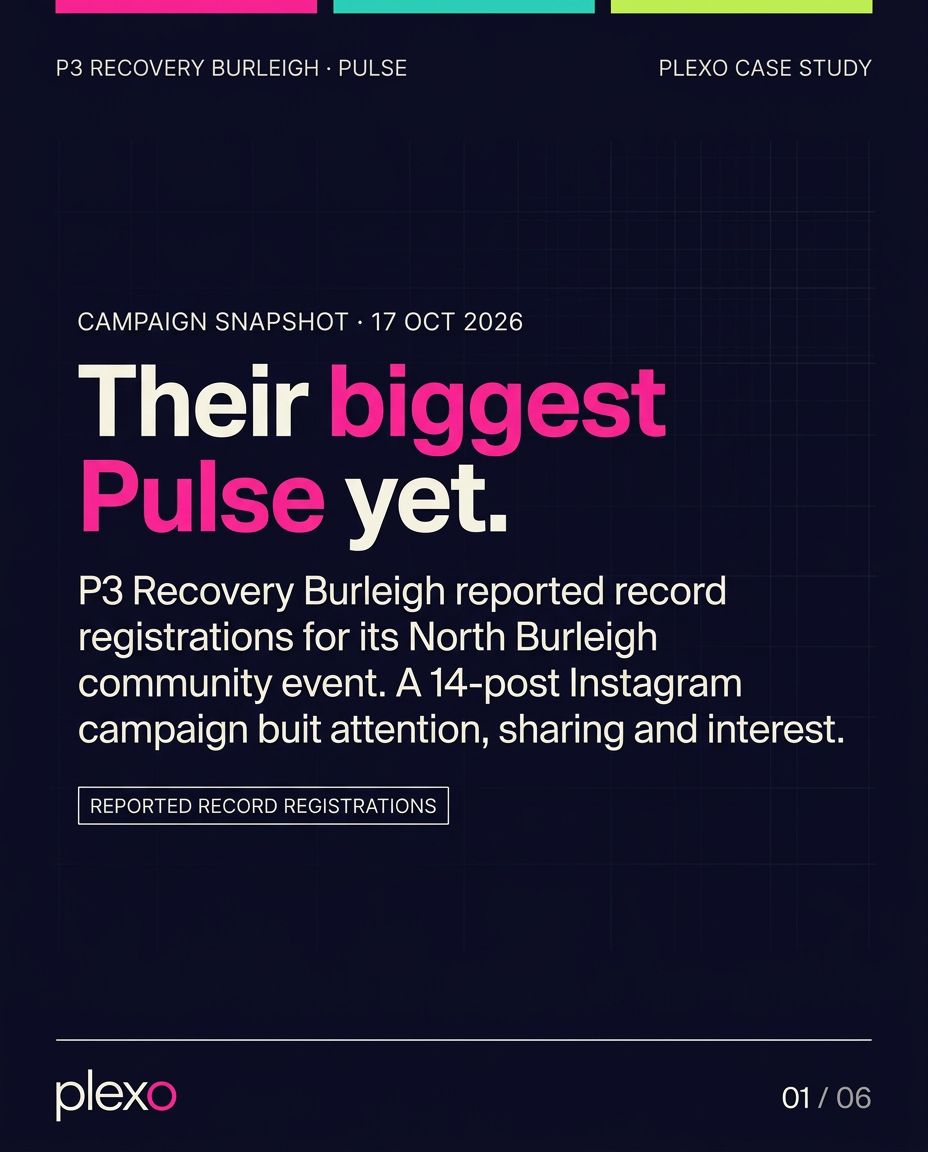
The local version is P3 Recovery Burleigh's Pulse. The October 2026 event in North Burleigh combined Pilates, a workout and a run, open to the public, and drew 741 registrations, the centre's biggest event to date. Across the May and October Pulse events, registrations passed 1,200.
Both succeed at the same job: putting the brand in front of people who were not looking for it.
Registrations are not loyalty
Reach tells you how many people saw you or signed up. It cannot tell you whether any of them came back. Getting noticed and getting chosen are separate problems, and the second one is where the money is.
The retention maths is well known. Research by Frederick Reichheld of Bain & Company found that a 5% increase in customer retention can lift profits by 25% to 95%, and studies cited in Harvard Business Review put the cost of acquiring a customer at five to 25 times the cost of keeping one.
Attention without attachment can also backfire. Tarte's lavish influencer trips drew millions of views and, in 2023, repeated backlash: TIME covered criticism of its Dubai trip as out of touch, and NBC News reported the CEO pledging to make its creator program more equitable after a creator said she was treated as "second-tier". A large guest list amplifies whatever the experience feels like, good or bad.
Free events add one more wrinkle: some of the crowd only ever comes for free. That is not a failure, but it means a registration count is the start of the measurement, not the result.
Attachment events: built to make people stay
An attachment event is for people already in your world: members on their twentieth visit, the coaches and physios who refer clients, local operators and partners. Industry Fridays is this format. The room is smaller on purpose, it recurs, and the goal is a relationship that outlasts any single offer.
A good attachment event says three things without saying them:
- We see you as more than a booking.
- We actually want to spend time with you.
- You are part of something bigger than a membership.
Once loyalty is emotional, a competitor's intro offer stops working. That is the return on a small room. It is also why these events look unimpressive in a recap deck: thirty people in a sauna will never photograph like seven hundred on a lawn.
Run clubs: the bridge between the two
Run clubs can do both jobs, which is why every brand seems to have one. Strava's 2024 Year in Sport report recorded a 59% increase in running club participation worldwide, and 58% of respondents said they had made new friends through fitness groups.
At the attention end, Nike's After Dark Tour drew more than 50,000 women to seven races across five continents in 2025. One in three were first-time racers, and the tour returned in 2026 across seven cities, including Sydney.
At the attachment end, Bandit Running built a paid membership around its runs and races. Glossy reports that members spend more than three times as much as non-members, refer an average of two new customers each, and have five times the lifetime value.
Case study: Running on Ragu, Gold Coast Marathon week 2026
Pace Athletic's Running on Ragu was a free shakeout run before the Gold Coast Marathon, with ASICS, Gemelli Italian and Dermalogica as partners. Registration was required, and all 300 spots were filled.
The event worked because every partner brought a different reason to come:
- Pace Athletic hosted the run and brought the shoe store to the park, with ASICS wear-test shoes off the Pace Truck.
- Gemelli Italian brought the carb load: pizza from its truck, and a sit-down Running on Ragu dinner menu.
- Dermalogica brought the after: skincare samples and goodies.
- A limited event tee carried every partner's logo, so the shared story went home with each runner.
The same week, Pace also ran a smaller Flow & Glow Pilates session with ASICS and Dermalogica, and an invite-only carb-load dinner with Gemelli. That is the full pattern in one week: an open run for reach, and smaller invited rooms for depth. Nobody discovers a brand at mile eight, and that is fine, because the people there already own the shoes.
Two events, two scoreboards
Judge each event on its own scoreboard. Grade a small Friday session on reach and it looks like a flop; grade a 700-person open day on return visits in its first week and it looks the same.
| Comparison | Attention event (Pulse-style) | Attachment event (Industry Fridays-style) |
|---|---|---|
| Job | Get found by new people | Keep the people you have |
| Who's in the room | Partners' audiences, creators, the public | Members, referrers, local industry |
| Size | Hundreds, open registration | Tens, by invite, recurring |
| Primary metrics | Registrations, first visits, trial bookings, reach, content made | Return rate, upgrades, referrals, what people say afterward |
| Measured over | The event and the following 2 to 4 weeks | Months |
| Typical failure | Big numbers, no follow-up path | Small numbers judged as a flop |
A customer dinner will always look small next to a festival weekend's earned media report. Put them in separate decks.
Four calls to make before you book anything
- Name the job. Reach, loyalty, referrals or sales. Decide before you look at a single venue.
- Fill the room for that job. Partners' audiences and creators when you want reach; members, regulars and industry when you want depth. Mixing them waters down both.
- Score it on the right board. First visits and trial bookings for the open event; return rate and referrals for the recurring one.
- Build the bridge. Let the open event and the run club bring new people in, then give them a smaller, recurring room worth coming back to. Plan the follow-up before the first registration opens.
The brands that get this right do not choose between attention and attachment. They run both, on purpose, and never judge one by the other's numbers.
Sources
- BeautyMatter, Coachella 2026 brand coverage, 20 April 2026 (rhode: $4.9M EMV, 818 posts, 521 creators)
- Nike, The After Dark Tour Is Back, 11 March 2026
- SGI Europe, Strava's Year in Sport report (2024 run club data)
- Glossy, How Bandit Running is expanding internationally while staying hyperlocal, 7 July 2026
- RunDais, Guide to Gold Coast Marathon Week 2026
- Pace Athletic, Gold Coast Marathon event wrap (2025 Running on Ragu format)
- Harvard Business Review, Amy Gallo, The Value of Keeping the Right Customers, 29 October 2014
- TIME, Tarte brand trips and influencer marketing, 2023
- NBC News, Tarte Cosmetics CEO pledges to make creator program more equitable, 2023
- P3 Recovery Burleigh, Pulse registration figures (May and October 2026), supplied by the organiser
Planning your next event?
Plexo helps wellness and performance brands build both sides: the events that get you found and the systems that make people stay.
Plan with PlexoNewsletter
Keep reading